
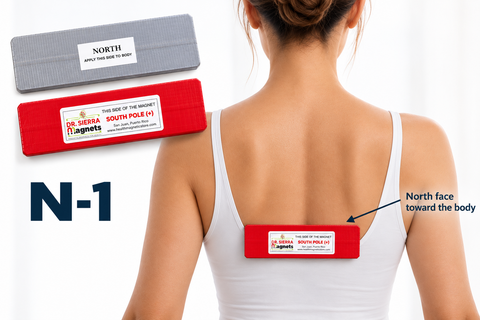
Understanding the history, magnetic strength, polarity, and versatility of one of our most recognized static magnets.
If you were going to purchase just one magnet to begin exploring biomagnetic wellness, why would I recommend the N-1?
The answer goes far beyond its magnetic strength.
For more than five decades, I have been surrounded by the study, application, and exploration of magnetic fields. Growing up with the pioneering work of my father, Dr. Ralph U. Sierra, and later incorporating biomagnetic practices into my own professional life, I learned something that continues to guide me today:
Not all magnets are created equal, and understanding the magnet you choose is just as important as owning one.
The N-1 is an excellent example of this philosophy.
Its substantial size, permanent magnetic field, clearly identified polarity, and versatile design make it one of the magnets I consider especially valuable for anyone interested in learning about static magnetic fields and incorporating them into a personal wellness routine.
But to appreciate the N-1, we should begin with its history.
A Magnet With a History: The Work of Albert Roy Davis
Long before magnetic wellness products became widely available online, Albert Roy Davis was writing about the characteristics of magnetic fields, the importance of polarity, and the practical applications of permanent magnets.
During the late 1960s, Davis discussed these magnets in his publications and provided readers with information about obtaining them.
The N-1 later appeared explicitly in his published work, including The Magnetic Blueprint of Life, which contains discussions of the N-1 Research Magnet and its North and South poles.
The Historical Connection Between Dr. Ralph U. Sierra and Albert Roy Davis
The collaboration between my father, Dr. Ralph U. Sierra, and researcher Albert Roy Davis is an important part of the history of biomagnetic research in Puerto Rico, beginning in the 1960s.
As documented in my book Power In A Magnet, my father's introduction to Davis followed his initial correspondence with Dr. A. K. Bhattacharya of India. Because of the geographical distance, Dr. Sierra was referred to Davis in Florida, where Davis was conducting magnetic research.
Their association began in 1966 and developed into years of research, correspondence, and the exchange of scientific observations. Dr. Sierra continued his investigations through the Puerto Rico Scientific Research Laboratory, studying magnetic fields and their applications.
An especially significant event occurred in December 1972, when Dr. Sierra and Albert Roy Davis participated in an international scientific meeting in Florida alongside researchers and physicians from Japan. The visiting researchers subsequently traveled to Puerto Rico to visit Dr. Sierra's laboratory.
My book also documents that two publications by Davis and Walter C. Rawls Jr., Magnetism and Its Effects (1974) and The Magnetic Effect (1975), included scientific applications developed by Dr. Sierra.
In Beyond the Power of the Magnet, I dedicate an entire chapter, “The History of Sierra and Davis,” to their history, scientific investigations, discoveries, and personal correspondence.
What makes this chapter particularly significant is the inclusion of excerpts from original letters exchanged during their years of research. These documents were preserved by my father, and I remain their custodian.
These historical accounts are particularly meaningful to me because they preserve the contributions of researchers whose work helped establish the foundations of the biomagnetic practices that I have continued throughout my professional career. Their work introduced me to a field that would become a lifelong professional interest.
For readers interested in the historical foundations of biomagnetism, I invite you to explore Power In A Magnet and Beyond the Power of the Magnet, particularly the chapter devoted to Sierra and Davis and their correspondence.
Historical References
Dr. Irma I. Sierra, Power In A Magnet:
- pp. 13–14: Dr. Sierra's introduction to Albert Roy Davis.
- pp. 33–34: The beginning of their research association in 1966.
- p. 37: The December 1972 scientific meeting and references to the 1974 and 1975 publications.
- p. 206: The continuation of Dr. Sierra's work and legacy.
Dr. Irma I. Sierra, Beyond the Power of the Magnet: chapter “The History of Sierra and Davis,” approximately pp. 32–50, including historical correspondence.
When I returned to Puerto Rico after earning my Doctor of Chiropractic degree, I began searching for the magnets described in those early publications because I wanted to incorporate them into my work with patients.
The N-1 became part of that continuing journey.
Today, through Health Magnetic Store & More, we continue making this type of magnet available while sharing the knowledge and history associated with its use.
The N-1 is not a newly invented magnetic wellness trend. Its history reaches back to the early literature of biomagnetism.
What Exactly Is the N-1?
The N-1 is a permanent, rectangular ceramic magnet manufactured from Grade 8 ferrite magnetic material.
Its specifications include:
| Characteristic | N-1 |
|---|---|
| Magnetic material | Grade 8 ceramic (ferrite) |
| Dimensions | 2 × 6 × ½ inches |
| Magnetic strength specification | Approximately 3,850 Gauss |
| Magnetic field | Permanent static magnetic field |
| Polarity | Identified North (–) and South (+) |
| Electricity or batteries | Not required |
Unlike a PEMF device, which uses electrical pulses to generate changing electromagnetic fields, the N-1 produces a continuous static magnetic field.
There is nothing to charge, program, or connect to an electrical outlet.
The magnetic field is an inherent characteristic of the permanent magnet itself.
This simplicity is one of the N-1's greatest practical advantages.
Understanding Magnetic Strength: Why 3,850 Gauss Is Only Part of the Story
One of the first questions customers ask about a magnet is:
“How many Gauss does it have?”
It's a reasonable question, but the answer requires some explanation.
Gauss is a unit of magnetic flux density, describing the strength of a magnetic field at a particular location.
However, the advertised Gauss specification of a magnet should not be confused with the magnetic field measured at every point around it.
Magnetic measurements depend on several factors, including the magnetic material, geometry, location of the measurement, instrument used, and distance from the magnet.
A magnet's field is not equally strong everywhere.
For example, measurements taken directly at or near a magnetic surface can be substantially different from measurements taken several inches away.
As distance increases, magnetic flux density generally decreases.
But the rate and pattern of that decrease depend on the magnet's shape, dimensions, and magnetic configuration.
This is why I have always emphasized the importance of understanding what we are measuring.
Two magnets can advertise similar Gauss ratings yet have very different dimensions and field distributions.
A small disc magnet and a large rectangular magnet are not necessarily interchangeable simply because their listed Gauss specifications are similar.
Gauss matters. But so do size, geometry, polarity, and distance.
The N-1 combines its Grade 8 ceramic material with a substantial rectangular design, providing a different magnetic configuration from that of a small disc or flexible magnetic strip.
For anyone seriously interested in biomagnetism, these physical distinctions are worth understanding.
Why the N-1's Dimensions Matter
The N-1 measures six inches long, two inches wide, and one-half inch thick.
That may sound like a simple specification, but dimensions are an important part of magnetic design.
A magnet's physical geometry influences the shape and distribution of its magnetic field.
The N-1's broad rectangular surface distinguishes it from small round magnets, flexible magnetic strips, and products containing multiple individual magnetic elements.
It also makes the N-1 practical as a standalone magnet.
Unlike a magnetic accessory manufactured for one specific body area, the N-1 is not permanently built into a garment, wrap, or band.
This gives users flexibility in how they incorporate the magnet into their personal routines.
Of course, a larger magnet is not automatically the best choice for every situation.
A flexible magnetic product may be more convenient when someone wants a wearable accessory. A smaller magnet may be preferable when compact size is the priority.
The N-1 offers something different: a substantial permanent magnet that can be used independently of a specialized wearable product.
Its versatility is one of the reasons I frequently recommend it as a starting point.
The Importance of North and South Magnetic Polarity
This is one of my favorite subjects, because polarity has been central to the biomagnetic knowledge passed down through my family.
Every permanent magnet has two magnetic poles, conventionally identified as North and South.
In the early work of Albert Roy Davis and Dr. Ralph U. Sierra, considerable attention was devoted to distinguishing these polarities and exploring their potential interactions with biological systems.
Their writings described different characteristics and proposed biological applications for North and South magnetic fields.
Within the Sierra approach, North (–) polarity has traditionally been associated with calming and regulating applications, while South (+) polarity has been discussed in more activating terms.
These descriptions belong to the historical framework of Sierra and Davis's biomagnetic work. They should be distinguished from established physical measurements and clinically demonstrated effects.
But one principle is especially important regardless of the application:
You should know which pole of a magnet you are using.
Magnetic polarity is a measurable physical property.
The orientation of the magnet matters when following instructions or discussing polarity-specific applications.
At Dr. Sierra Magnets, identifying polarity is an important part of our product philosophy.
We do not believe consumers should have to guess which magnetic pole faces a particular direction.
This is also why our emphasis on North Pole to Skin orientation is part of the identity of our magnetic product line.
The polarity matters. The orientation matters. Knowing what we use matters.
Why Ceramic Grade 8?
Permanent magnets can be manufactured from several different magnetic materials.
The N-1 uses ceramic ferrite material, commonly associated with durability, magnetic stability, and long-term use.
Ceramic magnets do not require electricity to maintain their magnetic field under ordinary conditions.
They are also generally resistant to corrosion and can retain their magnetic properties for many years when properly handled and stored.
In my experience, these ceramic magnets hold up well with proper care. Among the hundreds I have handled over the years, I recall only two or three breaking. I also take good care of them, which is an important part of that experience.
A hard fall or strong impact can chip or break a ceramic magnet, so avoid dropping it onto hard surfaces or allowing it to snap forcefully against another magnet.
When a magnet breaks, the pieces can remain magnetic, but this does not mean they are equivalent to the original intact magnet or suitable for continued use.
Proper handling helps preserve the magnet's physical condition for long-term use.
Static Magnetic Fields and PEMF: Two Different Technologies
Because we also work with pulsed electromagnetic field technology, I believe it is important for consumers to understand the distinction.
A permanent static magnet produces a magnetic field that remains essentially constant over time when the magnet is stationary.
A PEMF device uses electrical energy to create magnetic fields that vary over time according to the device's operating signals.
Both involve magnetism, but their physical characteristics are different.
A PEMF device may use programmed frequencies, pulse patterns, adjustable intensities, and electronic controls.
The N-1 requires none of these.
Its magnetic field is continuously present.
Neither technology should be assumed to produce the same biological effects simply because both involve magnetic fields.
Scientific studies must be evaluated according to the actual type of field, exposure conditions, and device being investigated.
Understanding that distinction helps consumers make more informed choices.
Why Would I Recommend the N-1 as Your First Magnet?
Over the years, I have worked with many magnetic products, including ceramic magnets, smaller discs, flexible magnetic materials, wearable accessories, and magnetic pads.
Each design has advantages.
Some products are created for convenience. Others are designed to conform to particular areas of the body or to be incorporated into everyday clothing.
The N-1 is different because of its simplicity and versatility.
It provides a substantial magnetic surface in one permanent magnet.
Its polarity can be identified.
Its physical characteristics are straightforward to explain.
It does not require batteries, electronic components, or recurring purchases to operate.
For someone who wants to begin learning about static magnets, these are meaningful advantages.
I also believe that beginning with one well-understood magnet can encourage people to learn more about magnetic strength, polarity, orientation, and the differences between magnetic products.
That knowledge is valuable regardless of whether they eventually choose additional magnets or wearable accessories.
My recommendation is not based simply on buying the strongest magnet. It is based on understanding what the N-1 offers and why its design is useful.
How Does the N-1 Compare With Other Dr. Sierra Magnets?
At Health Magnetic Store & More, we offer different magnetic products because people have different preferences and practical needs.
The N-1 is a large standalone ceramic magnet.
The Domino is a smaller ceramic magnet, offering a more compact format.
The N-2 provides another substantial rectangular configuration.
Our magnetic pads and wearable accessories incorporate magnets into products designed for convenient everyday use.
These differences are important.
A customer looking for a wearable magnetic neck product may prefer a Neck Band.
Someone interested in a magnetic lumbar accessory may find a magnetic belt more convenient.
A customer who wants a standalone permanent magnet for exploring biomagnetic practices may prefer the N-1.
There is no reason to assume that every customer needs the same product.
Choosing a magnetic product should begin with understanding its design, intended use, and the person's preferences.
What About the Research?
The historical literature of biomagnetism includes investigations, theories, observations, and discussions about magnetic fields and their potential biological interactions.
The work of Albert Roy Davis and Dr. Ralph U. Sierra is an important part of that history.
But the subject is broader than any one author or publication.
Modern research also examines static magnetic fields, pulsed electromagnetic fields, and their interactions with biological systems.
When reading this literature, it is important to distinguish between laboratory findings, theoretical explanations, individual observations, and clinical outcomes.
Not every result observed under experimental conditions translates directly into a benefit from a commercial magnetic product.
Similarly, research involving one type of magnetic exposure should not automatically be applied to another.
I believe the most meaningful way to study biomagnetism is to remain curious, understand the physical characteristics of the fields being discussed, and examine the original publications whenever possible.
That approach has guided my interest in magnetic science for decades.
More Than Five Decades of Knowledge and Experience
For me, biomagnetism is not simply a product category.
It is part of my family's history.
My father introduced me to a world of magnetic research, experimentation, and scientific curiosity long before many of today's wellness technologies existed.
His work and collaboration with Albert Roy Davis helped shape my understanding of the importance of magnetic polarity.
I continued exploring this field throughout my professional career, incorporating my education, practical experience, and continued interest in magnetic technologies.
Over time, I have seen new materials, new products, new electronic devices, and renewed interest in the science of magnetic fields.
Yet the fundamental questions remain relevant.
What type of magnetic field are we using?
How strong is it?
How is its polarity identified?
How does its geometry influence the surrounding field?
And what do we actually know about its applications?
These are the questions I want customers to consider.
They reflect a commitment to education that has always been part of the Sierra legacy.
Continue Learning: The Sierra Publications
For readers who want to explore biomagnetism beyond the information available in a product description, I encourage further reading.
My book Power In A Magnet includes my father's original Power of the Magnet, preserving his work as part of a broader educational resource.
My book Beyond the Power of the Magnet offers another opportunity to continue exploring the subject.
For Spanish-speaking readers, El Poder del Imán includes my father's original publication Energía Magnética.
And for someone who is fully bilingual and seriously interested in biomagnetic therapies, my personal recommendation is to explore Power In A Magnet together with my father's Energía Magnética.
These publications provide historical perspectives, foundational concepts, and additional opportunities for study.
They are part of the continuing effort to preserve and share the knowledge developed through decades of interest in biomagnetism.
Frequently Asked Questions About the N-1
Is the N-1 a regular magnet?
The N-1 is a permanent Grade 8 ceramic magnet with specific dimensions, an approximately 3,850-Gauss magnetic strength specification, and identified polarity. These physical characteristics distinguish it from many smaller or flexible household magnets.
Why is the N-1 called a research magnet?
The N-1 appears in Albert Roy Davis's published work, including references to the N-1 Research Magnet. Its history is connected to the early exploration of magnetic polarity and permanent magnetic fields.
Does the N-1 lose its magnetism?
Permanent ceramic magnets are designed to retain their magnetization over long periods under ordinary conditions. Excessive heat, strong opposing magnetic fields, or physical damage can affect their properties.
Is 3,850 Gauss the magnetic strength everywhere around the N-1?
No. Magnetic flux density varies with location and distance. The advertised specification should not be interpreted as a uniform field strength throughout the surrounding space.
Why is polarity identification important?
Identifying North and South poles allows the user to understand the magnet's orientation. This is particularly relevant when studying or following polarity-specific approaches described in the Sierra and Davis literature.
Does the N-1 need to be charged?
No. It is a permanent static magnet and does not require electrical charging.
Is the N-1 the same as a PEMF device?
No. The N-1 produces a static magnetic field. PEMF devices generate time-varying electromagnetic fields using electrical energy.
Is the N-1 better than a magnetic belt or pad?
They serve different practical purposes. The N-1 is a standalone magnet, while belts and pads are designed to provide convenient placement or wearability.
Can I use the N-1 every day?
The N-1 is a reusable permanent magnet. Appropriate handling, positioning, and safety considerations depend on the intended use. Strong magnets should be kept away from magnet-sensitive medical implants and devices unless compatibility has been established.
The N-1: A Magnet Worth Understanding
If there is one message I want you to take away from this article, it is that choosing a magnet should be an informed decision.
The N-1 has a history connected to Albert Roy Davis's pioneering publications.
Its Grade 8 ceramic construction, substantial dimensions, permanent magnetic field, and identified polarity make it a distinctive product within our magnetic collection.
For me, it also represents a connection between the early biomagnetic literature, my father's scientific legacy, and the knowledge I have continued developing throughout my professional life.
If you are considering your first standalone static magnet, I invite you to learn more about the N-1 and discover why it has remained part of our collection.
One powerful magnet. So many possibilities.
Dr. Irma I. Sierra
Health Magnetic Store & More
This article is intended for education about magnetic properties, historical research, and general wellness practices. It does not establish that the N-1 diagnoses, treats, cures, or prevents any disease.